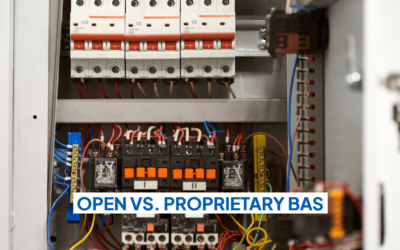

A data center runs on three control layers, not one. When they are designed to work together, the building protects itself. When they are bolted together late, the gaps show up at the worst possible time. Here is what each layer does and why the integration matters most.
The three layers
BMS (Building Management System) runs the cooling. It controls chillers, CRAC and CRAH units, pumps, and air handlers, holding supply temperatures and pressures to setpoint. Most of this runs on BACnet and DDC, often with PLCs on larger plants.
SCADA (Supervisory Control and Data Acquisition) is the layer operators live in. It pulls data from the BMS, the power systems, and field PLCs into one real-time view with trends and alarms. For AI and high-density loads we build SCADA on Ignition, where HBT holds Inductive Automation Premier Integrator status, often paired with Allen-Bradley PLCs.
EPMS (Electrical Power Monitoring System) watches the electrical backbone: utility feeds, switchgear, UPS, generators, and PDUs. It tracks load, power quality, and capacity, and flags trouble early. In our work the EPMS is delivered through SCADA, so power and cooling data sit side by side.
Why integration matters
Power and cooling are linked. A power event becomes a thermal event in minutes. When the three layers share data over open protocols, an alarm in one carries context from the others, and operators work from a single version of the truth instead of jumping between screens. A large site can carry around 70,000 monitored points, so one clear operating picture is what keeps a small issue from becoming downtime.
Why HVAC roots matter
A data center BMS is, at its core, a mechanical control problem. We have automated buildings since 1985 and data centers since 2006, work that now supports more than 4 gigawatts of capacity across 10 states and 6 countries. The product matters less than whether the people configuring it understand the mechanical systems underneath. Mechanical knowledge first, software on top.
Frequently asked questions
What is the difference between a BMS and SCADA in a data center? The BMS directly controls mechanical equipment such as chillers and air handlers. SCADA sits above it, pulling data from the BMS, power systems, and PLCs into one real-time interface for monitoring and control.
What does an EPMS do? It monitors the electrical infrastructure, from utility feeds and switchgear to UPS and generators, reporting load and power quality so operators catch electrical problems before they reach IT equipment.
Why integrate all three layers? Power and cooling affect each other, so a single integrated view with shared alarms lets operators act before a fault becomes an outage.
Talk to our data center controls team
The time to get the control strategy right is before the first server powers on. Schedule a complimentary facility audit and we will walk through your BMS, SCADA, and EPMS approach with you.
Industries: Data Centers, Services: Critical Technologies, Products: Ignition
—
About Us
Hoffman Building Technologies began as the controls division of Hoffman & Hoffman, a leader since 1947 in high quality HVAC products. Today we are a 100% employee-owned building automation specialist, designing, installing, and servicing the control systems that keep buildings running. More than 1,500 buildings across the United States and Europe run on our technology.