
A university is not one building. It is dozens, built across decades, each with its own controls, its own vintage, and its own quirks. Energy can eat 20 to 35 percent of a facilities budget, comfort complaints affect retention and reputation, and sustainability targets keep climbing. The hard part is rarely any single building. It is getting all of them to behave like one system.
That is what campus building automation does. Done right, it brings every building onto a single dashboard, so your team manages the campus instead of chasing it.
The problem: a patchwork no one designed on purpose
Most campuses did not choose their controls strategy. It accumulated. A building goes up in one decade with one brand of controls, another building gets a different system a few years later, and an older hall still runs on something close to original equipment. Over time you end up with a patchwork that nobody designed on purpose.
The cost shows up in a few predictable ways. Facilities staff jump between separate front ends just to see what is happening. Energy waste hides inside buildings that run full tilt whether they are occupied or empty. Labs need a level of airflow precision the rest of campus does not, and old systems struggle to hold it. And when a sustainability office asks for campus-wide energy data, pulling it together becomes a manual scramble.
The solution: integrate what you have, see it in one place
Campus building automation connects your buildings into one platform that monitors conditions and adjusts equipment in real time. The key is that you do not have to rip everything out to get there.
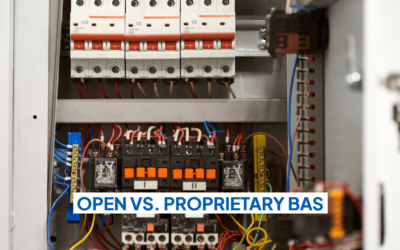
A vendor-agnostic integrator works in open protocols like BACnet, which means existing systems from different manufacturers can be brought together rather than replaced. That protects the money already invested in each building and lets the work happen in phases.
Once buildings are integrated, three things change. You get one view of the entire campus instead of a dozen logins. You can schedule and run equipment around real occupancy, so classrooms and halls are not conditioned at full load when no one is in them. And you get energy data in one place, which makes sustainability and ESG reporting far less painful.
What this looks like: High Point University
High Point University is a clear example. At the Congdon School of Health Sciences and the Wilson School of Pharmacy, a combined 222,000 square feet, we integrated nLight lighting controls, Aircuity, and Alerton onto a single BACnet platform. That platform controls the lab critical air valves and the fanwall HVAC, with full facility BACnet control across the building.
The results matter on two levels. Across the building, the university gained campus-style lighting control and real energy efficiency. Inside the labs, airflow is controlled precisely enough to support both instruction and research, where conditions have to be right for results to be valid. And for the facilities team, a complex mix of systems became something they can actually manage from one place.
As Troy Thompson of High Point University put it, the work was handled with “professionalism, knowledge, and a can-do attitude” in integrating complex building systems. For a project that touches teaching labs and research space, that confidence is the whole point.
Why vendor-agnostic wins on a campus
This is where the approach really separates. The national controls giants tend to push a single-brand ecosystem, which feels tidy until you are locked into one supplier for every future upgrade across every building. A campus is the worst place for that, because a campus is by definition a mix.
Integrating what you already have, in open protocols, keeps you free. You add new equipment where it earns its place, modernize older buildings in stages, and keep one coherent view across all of it. You own the system. It does not own you.
Where to start
The first step is a clear picture of how your buildings run today and where the realistic savings and integration wins are. We offer a complimentary facility audit for campuses that does exactly that, with no obligation, so any decision you make is grounded in your actual buildings.
Schedule a complimentary campus facility audit
Frequently asked questions
What is campus building automation?
It is a single platform that connects the HVAC, lighting, and other building systems across a campus so they can be monitored and controlled together, rather than building by building on separate systems.
Do we have to replace our existing building controls?
Usually not. Working in open protocols like BACnet, an integrator can bring existing systems from different manufacturers onto one platform and modernize in phases, which protects what you have already invested.
How much can a university save on energy?
It depends on the age and condition of the buildings. Higher education facilities commonly target reductions in the range of 20 to 35 percent of energy use through demand-based control and integration, with the exact figure depending on where the waste is today.
Can one system handle both ordinary classrooms and sensitive labs?
Yes. The same platform can run standard spaces efficiently while holding the tighter airflow and pressure that teaching and research labs require, as the High Point University labs show.
How does this help with sustainability reporting?
When every building reports into one platform, energy and performance data lives in one place. That makes campus-wide and ESG reporting far easier than pulling numbers from separate systems by hand.
About the author
Will Carter is Director of Sales at Hoffman Building Technologies. He works with colleges, universities, hospitals and other facility owners across the Southeast on building automation and systems integration.
About Us
Hoffman Building Technologies has been a building automation specialist since 1985. We are 100% employee-owned and serve colleges, universities, and other facilities across the United States and Europe. We manage more than 1,500 buildings and integrate the platforms a campus already has rather than locking it into one brand.
Industries | Services | Home | Contact Us | News & Blogs