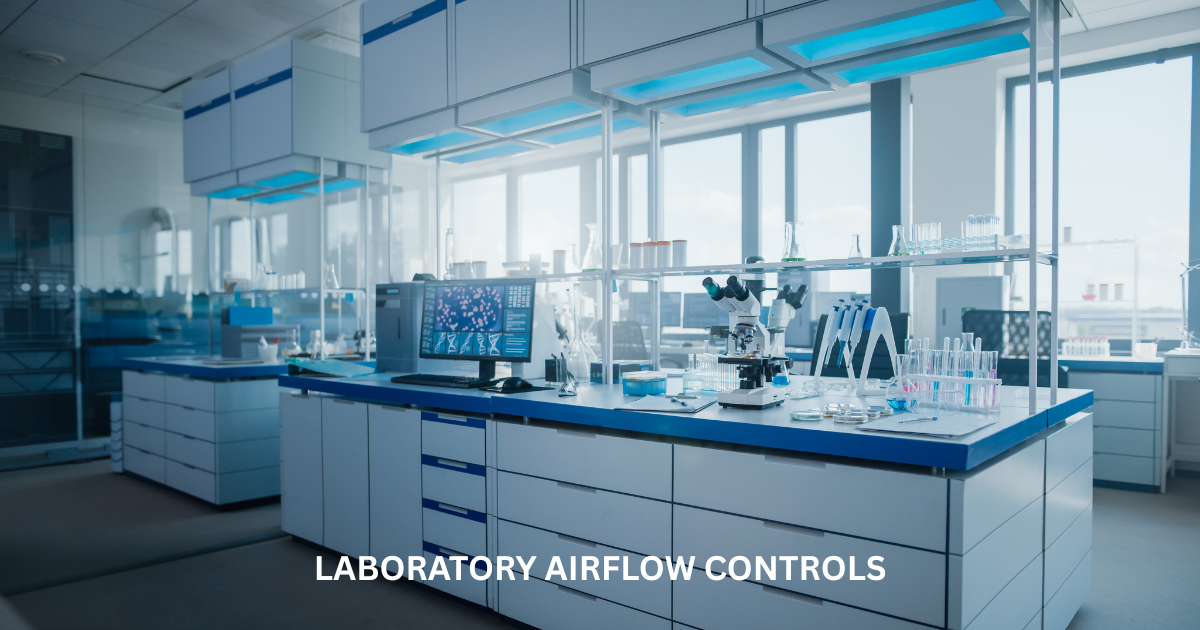
In a laboratory, the air is not a background detail. It is part of the experiment and part of the safety system. Airflow, pressure, temperature, and humidity decide whether a fume hood keeps a researcher safe, whether a cleanroom stays clean, and whether a result can be trusted. Get the air wrong and you do not just waste energy, you risk people, research, and compliance.
Labs are also expensive to run. They use several times the energy of a typical office building, because they move so much conditioned air and often run on 100% outside air. That combination, high stakes and high cost, is exactly why airflow control deserves real engineering.
The problem: labs are unforgiving, and usually wasteful
A lab has to do several hard things at once. Fume hoods need enough face velocity to contain fumes, every time, without fail. Rooms need the right pressure relationship with their neighbors, negative for containment, positive for a cleanroom, and that relationship has to hold even as hoods open and close. Air change rates are high. Temperature and humidity often have tight tolerances for sensitive equipment and materials.
Older labs meet those demands by brute force. They run constant high airflow around the clock whether the space is busy or empty, because that felt like the safe choice when the controls were simple. The result is a building that is safe on a good day, drifts out of spec on a bad one, and burns enormous amounts of energy either way. On top of that, regulated labs have to prove their conditions held, and manual documentation is slow and error prone.
The solution: precision airflow under real control
The answer is a control system built for the speed and stakes of a lab, not a general building system stretched to fit.
Fast, precise airflow. Modern airflow valves respond in fractions of a second, so a fume hood holds its face velocity and a room holds its pressure even as sashes move and loads change. This is the heart of lab safety, and it is where our precision airflow expertise, including our work as a Phoenix Controls Platinum Dealer, matters most.
Demand-based ventilation. Instead of running full airflow at all times, sensing systems such as Aircuity measure what is actually in the air and adjust ventilation to match. When a space is clean and empty, air changes safely drop, which is where most of the energy savings come from.
Pressure that holds. Containment and cleanroom pressure relationships are managed continuously, so the boundary between a lab and the rest of the building stays where it belongs.
Validation built in. The system documents conditions automatically, which supports IQ, OQ, and PQ validation and standards such as FDA 21 CFR Part 11 and ISO 14644 for cleanrooms. The proof is captured as you go, not reconstructed later.
Done this way, labs commonly cut energy use by 15 to 25 percent, and they do it without ever loosening the safety and validity requirements. Those are fixed. The savings come from the hours and spaces where high airflow was never actually needed.
What this looks like: High Point University
At High Point University, we handled the lab controls for the Congdon School of Health Sciences and Wilson School of Pharmacy. Every lab in the building has airflow control precise enough to support both classroom instruction and research, where conditions have to be right for results to be valid, all managed through full-facility BACnet control. It is a clear example of lab-grade precision and whole-building integration working together.
Why an airflow specialist matters
Lab controls are unforgiving, so experience shows. We have deep HVAC and mechanical roots going back to 1985, precision airflow expertise for fume hoods, pressure, and cleanrooms, and we are vendor agnostic, so we integrate the systems a lab already has rather than forcing a single brand. For a Lab Director, Facility Manager, EHS Officer, or research leader, that means safety that holds, results you can defend, and a serious cut in the energy a lab wastes.
Where to start
The first step is a clear read of how your lab runs today, where airflow and pressure are at risk, and where energy is being spent that does not need to be. That is what a facility assessment provides.
If you want to see what is possible in your lab, schedule a complimentary facility audit. It is a no risk way to find the safety gaps and the savings before you commit to anything.
Schedule a complimentary facility audit
Frequently asked questions
Why do laboratories use so much energy?
Labs move large volumes of conditioned air, run high air change rates, and often use 100% outside air, which uses several times the energy of a typical office. Demand-based ventilation is how that comes down safely.
Can you save energy in a lab without compromising safety?
Yes. Safety requirements like fume hood face velocity and room pressure are treated as fixed. Savings come from reducing airflow only in the spaces and hours where high airflow was never needed, commonly 15 to 25 percent.
What controls a fume hood’s safety?
Fast-responding airflow valves maintain the hood’s face velocity as the sash moves, so containment holds. Precision and speed are what keep the researcher safe.
How do lab controls support compliance and validation?
The system continuously documents conditions, which supports IQ, OQ, and PQ validation and standards such as FDA 21 CFR Part 11 and ISO 14644 for cleanrooms, so the record is ready for auditors.
What is the first step?
A facility assessment that shows where airflow and pressure are at risk and where energy is being wasted, so any decision is grounded in your actual lab.
About the author
Bryan Lampley, PE, CSE, LEED AP, is Director of Critical Technologies at Hoffman Building Technologies. He has more than three decades in the controls industry and leads HBT’s work in critical environment automation, including laboratories, healthcare, and data centers.
About Us
Hoffman Building Technologies has been a building automation specialist since 1985. We are 100% employee-owned and serve laboratories and other critical facilities across the United States and into Europe. We integrate the platforms a facility already has rather than locking it into one brand.
Home | Laboratories | Critical Environments | Contact Us | News & Blogs