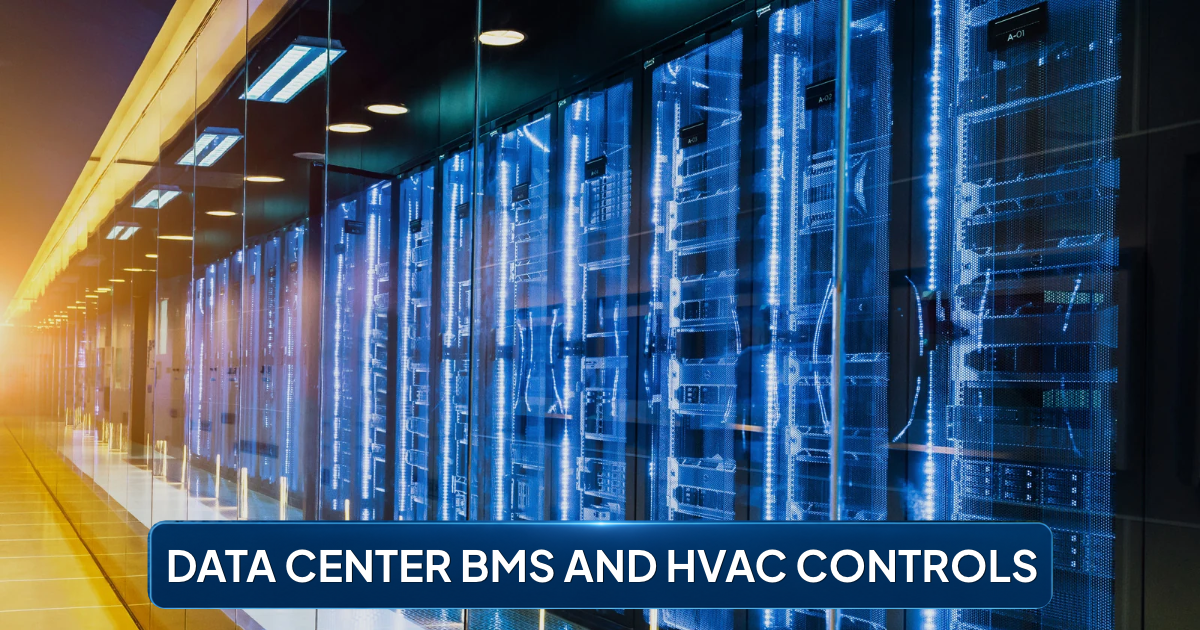
Racks get the attention. The cooling and power systems behind them decide whether those racks stay online.
The Load Keeps Climbing
The U.S. Department of Energy reports that data centers used about 4.4% of U.S. electricity in 2023, or 176 TWh. A Lawrence Berkeley National Laboratory study projects that share could reach 6.7% to 12% by 2028, with AI applications named among the drivers. Every one of those kilowatts ends up as heat, and a mechanical plant has to remove it. That puts the controls system in the critical path.
Three Systems That Have to Act as One
On paper, a data center has a building management system. In practice it has three control layers:
- Airside. CRAH units, fan walls, and air handlers, usually on BACnet DDC controllers.
- Plant. Chillers, pumps, and heat rejection, often on redundant PLCs, because a plant failure takes the whole hall with it.
- Power. The electrical power monitoring system, or EPMS, which reads meters, relays, UPS units, and generators over protocols like Modbus TCP and BACnet IP, usually into a SCADA platform such as Ignition.
Each layer is manageable alone. The trouble sits at the seams, where an airside setpoint depends on a plant status and an alarm needs a power reading. That is where integration quality shows.
Where HVAC Roots Make a Difference
We have designed HVAC and controls since 1985, and we designed and built our first data center in 2006. That mechanical background changes how we build the control system:
- Sequences written from the plant outward. We read the P&IDs and the sequence of operations together, so a staging gap or a missing failure mode shows up on paper instead of at startup. On some jobs we have written sequences that were missing from the design package.
- Failure modes first. We ask what the plant does when a chiller trips under full load before we ask what it does on a mild day.
- Open protocols. BACnet, Modbus TCP, and OPC UA keep the owner free to change equipment later, which we covered in our post on open vs proprietary BAS.
Details That Make a BMS Hard to Break
- Redundancy. Redundant PLCs and servers, so one failure does not leave operators blind.
- Battery room safety. Hydrogen and lithium ion off gas detection tied into the BMS, with alarms and exhaust response.
- One console for leaks and fuel. Leak detection and fuel oil monitoring sit in the same system as the cooling plant.
- Testing before site. Factory witness testing before equipment ships, then staged commissioning, so startup is not the first time the logic runs.
- Version control. SCADA code kept in source control, so every change is tracked and can be rolled back.
- Security habits. Controls that share a network with IT need the password and firmware discipline we covered in BAS cybersecurity basics.
What That Looks Like in Practice
HBT has completed 25+ hyperscale and mission critical data center projects since 2006, representing 5GW+ of capacity across the U.S. and Europe. On average, our installations monitor about 70,000 points. Many of our data center clients ask us not to name them, so we describe the work by scale and scope. You can see how our Critical Technologies team and our systems integration work fit together, and what we do across data centers.
Five Questions to Ask Any Data Center Controls Partner
- Who writes the sequences of operations, and have they run a chiller plant?
- What happens to controls if one PLC or server fails?
- How does EPMS data reach the operator, and over which protocols?
- When is the logic tested before site startup?
- Who supports the system after turnover?
FAQ
What is a data center BMS?
A building management system that controls cooling equipment, monitors environmental conditions, and raises alarms. In a data center it usually covers airside units, the chilled water plant, and supporting systems such as leak and gas detection.
What is the difference between a BMS and an EPMS?
The BMS handles cooling and environmental controls. The EPMS monitors the electrical side, including meters, relays, UPS units, and generators. Owners need both, and they work best when they share one view.
Why do data center chiller plants often use PLCs?
PLCs are widely used where redundancy and fast, predictable control matter. Many plant level systems run on them while airside equipment stays on BACnet DDC.
How much U.S. electricity do data centers use?
About 4.4% in 2023, according to the U.S. Department of Energy, with a projected range of 6.7% to 12% by 2028.
Planning a Data Center or Expanding One?
Get a Complimentary Facility Audit
About the author
Bryan Lampley is Director of Critical Technologies at Hoffman Building Technologies. He works on controls and systems integration for data centers, pharma, and other critical facilities.
About Us
Hoffman Building Technologies has been a building automation specialist since 1985. We are 100% employee-owned and serve government and other facilities across the United States and into Europe. We integrate the platforms a facility already has rather than locking it into one brand.
Home | Government | Services | Contact Us | News & Blogs