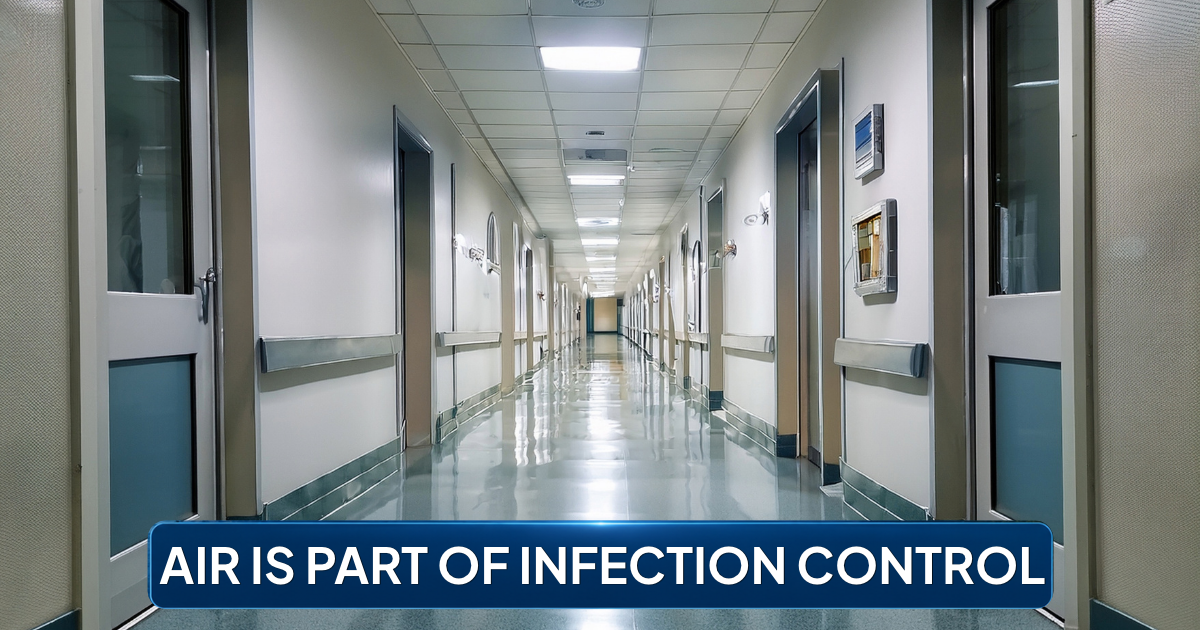
Cleaning and hand hygiene get most of the attention in infection control. The air moving through a hospital gets far less, even though it can carry airborne germs from room to room without anyone noticing.
Why Air Matters in a Hospital
The CDC reports that on any given day in 2023, about 1 in 38 hospital patients had at least one healthcare associated infection. Not all of those spread through the air, so this is not an HVAC problem alone. It does show why every layer of defense counts, including the one you can’t see.
The HVAC system’s job here is simple to state. Move air in the right direction, at the right rate, and keep it that way.
Pressure Relationships Do the Quiet Work
Air flows from higher pressure to lower pressure. That one fact decides where germs can drift. Isolation rooms for airborne infections are held negative, so air flows in and stays contained. Protective rooms and many operating rooms are held positive, so outside air stays out. Get the pressure relationship wrong and the room works against you.
Those relationships are easy to lose. Doors get propped open, filters load up, damper actuators drift, and sensors fall out of calibration. Picture a Monday morning where an isolation room has sat near neutral all weekend because a door closer failed and the only check was a daily gauge reading. Nobody did anything wrong. The system just had no way to say so.
The CDC’s tuberculosis guidelines advise monitoring and recording airflow direction in isolation rooms daily while they are in use. That is a minimum. A daily check can’t catch a problem that starts an hour after the check.
What a Good BAS Does About It
A building automation system can watch these rooms all day, not once a day. Here is what we build in:
- Continuous pressure monitoring with local and remote alarms, so a drifting room is flagged in minutes, not at the next round.
- Trend logs, so you see slow drift before it becomes a failure.
- Alarm routing and escalation, tested after hours, so the right person gets the call.
- One dashboard for critical rooms, across isolation rooms, operating rooms, and labs, even when the equipment comes from different manufacturers.
We are vendor agnostic. We work with Alerton, Distech, and Phoenix Controls room pressure monitoring, so we match the system to the room, not to one manufacturer’s catalog.
At Moses Cone Hospital’s North Tower, our Cone Health project pairs an Alerton BAS with Aircuity demand based ventilation and BACnet integrated operating rooms and critical labs. The result was 40% energy savings compared with similar hospital projects and 99.8% uptime.
Five Checks for Facility Teams
- List every room with a required pressure relationship, and who owns each one.
- Confirm each room has continuous monitoring and an alarm, with a gauge as backup.
- Review trends monthly for slow drift.
- Test alarm routing after hours, including who answers and how fast.
- Verify again after any renovation or equipment change.
Requirements for each space come from standards such as ASHRAE 170, Ventilation of Health Care Facilities, and from your engineer of record. Use the BAS to prove you are meeting them. We covered similar pressure ideas for labs in our post on pharma cleanroom HVAC controls.
FAQ
Can HVAC help reduce hospital infections?
It is one layer of defense. Ventilation, filtration, and pressure relationships help control airborne spread, alongside cleaning, hygiene, and other practices. The CDC reports about 1 in 38 hospital patients had a healthcare associated infection on a given day in 2023, and not all of those spread through the air.
What is a negative pressure room?
A room held at lower pressure than its surroundings so air flows in, not out. Hospitals use them for patients with airborne infections. The CDC advises monitoring and recording airflow direction in these rooms daily while they are in use.
How often should room pressure be checked?
Your policies and codes set the schedule. The CDC’s tuberculosis guidance advises daily checks of airflow direction in isolation rooms in use. Continuous monitoring with alarms adds coverage between those checks.
What does ASHRAE 170 cover?
ASHRAE 170, Ventilation of Health Care Facilities, addresses ventilation design for health care spaces. Confirm the targets for each room type with your engineer of record.
Want a Second Set of Eyes on Your Critical Rooms?
Get a Complimentary Facility Audit
About the author
Bryan Lampley is Director of Critical Technologies at Hoffman Building Technologies. He works on controls and systems integration for data centers, pharma, and other critical facilities.
About Us
Hoffman Building Technologies has been a building automation specialist since 1985. We are 100% employee-owned and serve government and other facilities across the United States and into Europe. We integrate the platforms a facility already has rather than locking it into one brand.
Home | Government | Services | Contact Us | News & Blogs